
The hidden danger of hearing protection that can cost you your hearing
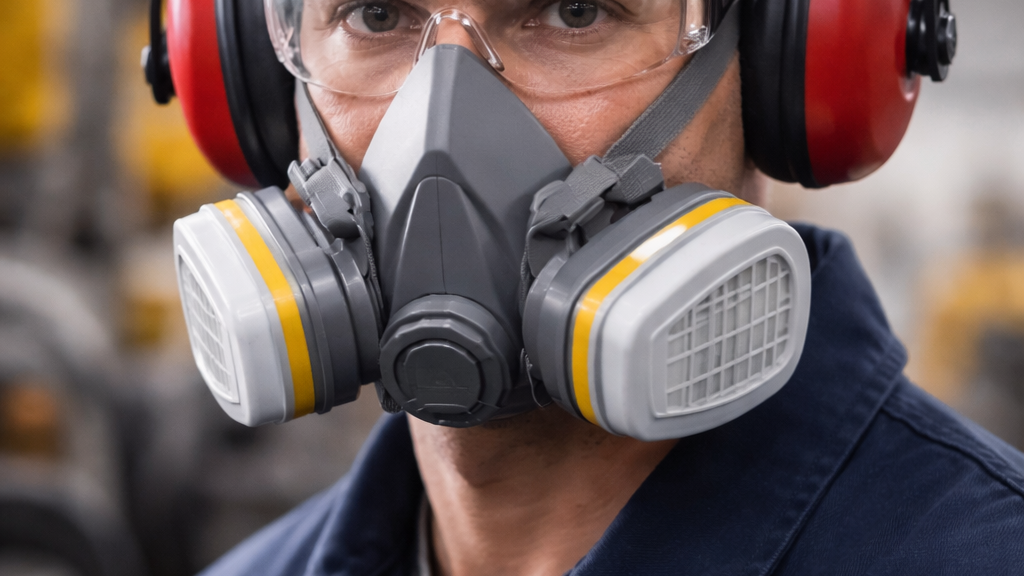
In many productions and workshops, one type of PPE is not enough. You often end up wearing several things at the same time: helmet, safety glasses and sometimes a respirator – and then head protection on top.
It looks correct from a distance.
The problem is that hearing protection is extremely dependent on a tight seal against the skin. And that seal is exactly what safety glasses and respirator straps tend to break.
What the research actually shows
Two studies by Abel et al. measured what happens to the attenuation of head protection when used with other safety equipment close to the head:
- One study found that attenuation was close to the manufacturer’s specifications when the headgear was “clean”. However, it dropped up to ~5 dB when wearing safety glasses or a half-mask respirator, and up to ~9 dB when wearing both simultaneously.
- The results also point out that the loss is often evident at low frequencies because sound can “seep” in through small gaps – typically at spectacle temples or straps.
It’s worth pausing: 9 dB might sound like “a little”. It isn’t.
Why 9 dB is a big deal and increases the risk of hearing loss
As noise levels rise, the strain on hearing increases rapidly. A rule of thumb from occupational health and noise calculations is:
- +3 dB = double the noise dose = halving the time you can tolerate the noise (for the same load).
So +9 dB means in practice:
- A loss of ~9 dB in real attenuation can mean up to 8× higher noise dose for the same working time – and thus a significantly higher risk of noise-related hearing loss over time
Bottom line: If your hearing protection loses ~9 dB in practice due to glasses/respirator, the employee can get a significantly higher noise exposure – even if it “looks right” and all PPE is on.
“But we’ve chosen head protection with a high SNR…”
It only helps if the seal is intact. When there’s a leak at the ear cushion, the actual attenuation drops.
So what do you do? Practical choices that actually work
If the employee has to wear safety glasses and/or a respirator as part of the job, it often makes sense to consider molded hearing protection rather than over-the-ear protection.
Why molded is often a better match when wearing multiple pieces of protective equipment at the same time
- No ear cushions to fit snugly against the skin → glasses and straps do not create a “gap”.
- More space around the head → fewer conflicts with helmet, visor, respirator and glasses.
- More stable solution over a full day → less temptation to lift the hearing protection “just in time”.
Audiovox recommendation
When the user has to wear glasses and/or a respirator as a regular part of the job, we recommend choosing molded hearing protection as a starting point – precisely to avoid the leakage that the research documents.

Sources:
Abel, S.M.; Sass-Kortsak, A.; Kielar, A. (2002). The effect on earmuff attenuation of other safety gear worn in combination. Noise & Health, 5(17), 1-13.
Abel, S.M.; Sass-Kortsak, A.; Kielar, A. (2001). Hearing Protectors, Safety Glasses and Respiratory Protective Equipment: Effect on Sound Attenuation. Defense R&D Canada, Technical Report (DCIEM TR 2001-140).


